I just spent the last hour scrolling through a massive comment war in an AI creator group, and honestly? My brain hurts. It started over something that seems so simple: a page took an AI-generated image from a creator, slapped their own logo on it, and claimed it as theirs. The creator was furious. The page’s fans were shouting, “It’s AI! It’s open source! Nobody owns it!” It was a total mess of insults, “common sense” logic, and a whole lot of misinformation. It made me realize that most of us are using these incredible tools every day—Gemini, Midjourney, Stable Diffusion, without actually knowing where the legal lines are drawn. So, I decided to stop scrolling and start digging. I wanted to know: if I spend three hours perfecting a prompt, is that image *mine*, or am I just borrowing it from the void?
The truth, as it turns out, is a bit of a “Wild West” scenario, but it’s not quite as lawless as the “re-posters” want you to believe. We are living in this weird gap where technology has sprinted miles ahead of the legal system. In 2026, the rules are finally starting to take shape, but they aren’t always what you’d expect. If you’re using AI images for your website, your brand, or your clients, you really can’t afford to guess. One wrong move and you’re not just dealing with “cancel culture”; you could be looking at a serious copyright strike or a brand reputation that’s permanently stained.
What the Law says (and doesn’t say) about AI generated images
I dug into Chapter 2 of the US Copyright Law to see how they handle ownership. Section 201(a) is pretty clear: copyright starts with the ‘author.’ But here’s the kicker: the law also says in Section 202 that owning a physical copy (or a digital file on your hard drive) is not the same as owning the copyright. Just because you can download it doesn’t mean you can slap your logo on it and call it yours. To legally transfer a copyright, Section 204(a) says you need a signed, written agreement. So, unless Midjourney or Google literally signs a paper over to you, that ‘ownership’ you think you have might be a lot thinner than you imagine
When I started looking into international laws, the first thing I realized is that “common sense” doesn’t apply here. In the US, the Copyright Office has been pretty brutal. Their stance is simple: no human author, no copyright. They’ve basically said that if you just give a machine a prompt and it does the “traditional elements of authorship,” the machine is the creator. And since a machine isn’t a person, the image goes straight into the public domain. It doesn’t matter if you paid for the subscription. It doesn’t matter if you think the prompt was “genius.” To them, it’s like telling a commissioned artist to “paint a sunset”, the artist owns the copyright, not the person who gave the suggestion. Only in this case, the artist is an algorithm, so *nobody* owns it.
But then I looked at China, and things got interesting. A court in Beijing recently ruled that an AI image *could* be protected if the human creator could prove they had significant creative control. We’re talking about choosing the lighting, the composition, the specific prompts, and iterating dozens of times to get a specific result. This is a huge deal. It suggests that as we move through 2026, the law might start rewarding the *effort* and the *intent* behind the prompt, rather than just the final click. Meanwhile, the UK and parts of the EU are still debating, but the trend is leaning toward transparency. They want you to label everything. They don’t want to play guessing games with what’s human-made and what’s not.
The takeaway for me? You can’t just assume you have a legal shield. If you’re in a country that requires “human authorship,” your raw AI output is basically up for grabs legally, even if it feels morally wrong. This is exactly why those internet dramas get so heated—people are arguing about what’s “fair” while the law is arguing about “definitions.”
What Do the Tools Say? (Gemini vs. Midjourney)
I also went down the rabbit hole of Terms of Service. Let’s be real, nobody reads those, but for AI creators, they are the only “contract” we have. Google’s Gemini is pretty chill about it.
Essentially, Google is saying: “We gave you the brush, but you’re responsible for what you paint.” They remind users that by using the app, you agree not to violate others’ copyright or privacy rights. This is a huge red flag for anyone thinking AI is a free pass to scrape or mimic. If you use Gemini to generate something that infringes on a real artist’s work, Google isn’t going to bail you out. They even reserve the right to remove images if they detect a violation of their **Prohibited Use Policy**. So, even if you think you “own” the result, the platform still has the ultimate kill switch.
Their current policy generally says they won’t claim ownership of what you create. It’s yours to use. However, they also get a very broad license to use your content to make their models better. It’s a bit of a “give and take.” You get the image, they get the data. It’s a fair trade for most, but it’s definitely not “private” ownership.
Read more: https://support.google.com/gemini/answer/14286560#
Midjourney is the one that really gets people confused. If you pay for a plan, they tell you that you “own” the assets you create. You can sell them, use them for a book cover, or put them on a t-shirt. But here is the catch that I think a lot of people missed in that drama I saw: if you’re using the public rooms, Midjourney keeps a license to use and remix your work. And more importantly, Midjourney can’t overrule the government. Even if Midjourney says “you own it,” if the US Copyright Office says “AI art can’t be copyrighted,” Midjourney’s terms can’t protect you in a real court of law against a third party. They are giving you the right to use the image *within their ecosystem*, but they aren’t giving you a global legal patent.
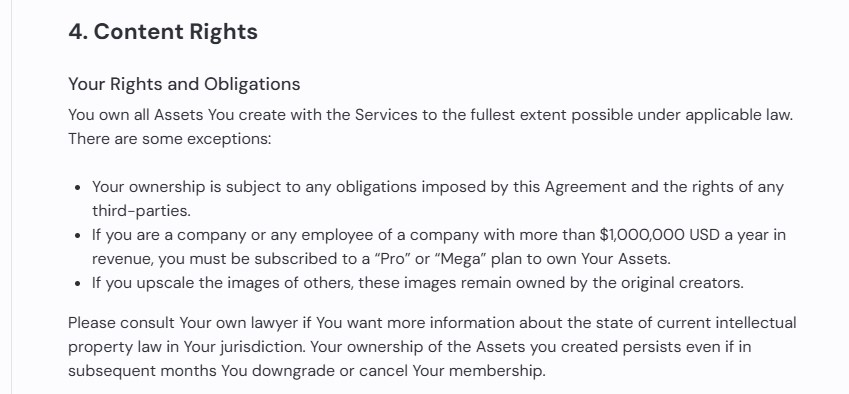
Read more at: https://docs.midjourney.com/hc/en-us/articles/32083055291277-Terms-of-Service
One cool thing I found is how these companies are trying to protect us from ourselves. Google is using something called SynthID, which is basically an invisible watermark. It doesn’t ruin the art, but it tells the internet, “Hey, this was made by an AI.” It’s their way of helping with the transparency that governments are starting to demand. It’s a tech solution for a legal headache.
When does a prompt become a “Work of Art”?
This is where the debate gets personal. The person who “stole” the image in the drama I saw argued that “anyone could have typed that prompt.” But anyone who actually uses AI knows that’s garbage. There is a massive difference between a “5-second prompt” and a “3-hour masterpiece.” I’ve seen creators use Inpainting to fix hands, adjust light sources with ControlNet, and upscale images through multiple stages. At that point, is the AI really the author? Or is it just a very advanced version of a Photoshop brush?
The community is starting to draw a line: if you can demonstrate a deliberate creative process, you have a much stronger moral (and potentially legal) claim. If you have the “receipts”—the early versions, the refined prompts, the layers—you’re an artist. If you just got lucky with one click, you’re just a user. This distinction is vital. As someone who manages websites, I’ve started keeping a “generation log” for any major asset. If anyone ever tries to claim my brand’s images are just “public domain trash,” I have the proof of the work that went into them. It’s about showing your work, just like in math class.
Why “credit” still matters even if you can’t sue
This was the biggest flashpoint in the drama. “If I can’t sue you, I can take it.” That’s the logic people use to justify stripping watermarks or re-posting without a tag. But here’s the thing: the internet is a small place. In the AI world, your reputation is your only currency. If you build a brand on stolen prompts or uncredited art, you are building on sand. The community will find out, and they will be loud about it.
Demanding credit isn’t about being a “copyright snob.” It’s about acknowledging the human who spent the time to explore the latent space and find that specific, beautiful result. When we give credit, we’re saying, “I see the effort you put in.” When we take without asking, we’re saying, “Your time is worth nothing to me.” Even if you win the legal argument, you lose the respect of your peers. And for a business, that kind of negative PR is way more expensive than just hiring a creator or generating your own original assets.
The hidden risks of “Borrowing” AI content
If you’re a business owner reading this, please listen: do not just grab a “cool AI image” from Pinterest or a random Facebook group for your website. It is a trap. Beyond the drama and the ethics, there are three huge risks you’re taking:
First, you don’t know what’s in that image. AI models are trained on real art. If the image you “borrowed” looks a little too much like a famous illustrator’s style or contains a distorted trademark, you could be on the hook for copyright infringement that has nothing to do with AI and everything to do with the training data. Second, you lose your brand identity. If you’re using the same “cool AI girl” that fifty other blogs are using, your brand looks cheap and unoriginal.
Third, and this is the SEO geek in me talking: search engines are getting scarily good at identifying AI content. If you are re-posting unoriginal AI images that have already been indexed a thousand times, you aren’t helping your rankings. Google wants “helpful, original content.” Re-posting someone else’s Midjourney output is the opposite of that. You’re much better off spending the twenty minutes to generate something unique to your brand and marking it with your own watermark so others don’t do to you what I saw in that drama today.
Final Verdict: Your AI Copyright Cheat Sheet
After diving deep into global laws, reading the fine print of Gemini’s Nano Banana policies, and even nerd-ing out on Chapter 2 of the US Copyright Act, I’ve boiled everything down into three simple answers. If you’re a creator or a business owner, this is what you actually need to know to stay out of trouble.
1. Who actually owns the AI-generated image?
The short answer? It’s complicated, but usually, nobody owns the legal copyright to a raw AI image. According to Section 201(a) of the US Copyright Law, copyright belongs to the “author”—and currently, the law defines an author as a human, not an algorithm. While tools like Midjourney give you “ownership” in their terms, they can’t override national laws. If you just typed a quick prompt, the image is likely in the Public Domain. However, if you spent hours refining, editing, and layering that image (what courts in China are now calling “significant creative contribution”), you have a much stronger claim to authorship. Bottom line: Ownership is earned through human effort, not just a single click.
2. Can you get sued for re-using someone else’s AI art?
In terms of “Copyright Infringement,” a lawsuit is unlikely because most raw AI art isn’t legally protected. But don’t start celebrating yet. You can still get hit with a Right of Publicity lawsuit if the image looks too much like a real person, or a Trademark suit if it mimics a famous brand’s style. More importantly, you face “Social Cancellation.” As I saw in that Facebook drama, the community doesn’t care about legal loopholes. If you take someone’s work and slap your logo on it, they will hunt you down publicly. The risk isn’t just a courtroom; it’s a permanent black mark on your brand’s reputation.
3. How should you responsibly re-use AI images?
If you find an AI image you love and want to use it, follow the “Decent Human” rule. First, always give credit. Even if you remove watermark, tag the prompter or mention the tool used. It costs you nothing and buys you respect. Second, transform it. Don’t just copy-paste. Use the image as inspiration or a base layer, then add your own design elements to make it original. Third, never strip away existing watermarks. Section 202 of the law reminds us that owning a file isn’t the same as owning the rights. If an artist put their mark on it, respect it. If you need a clean image for your brand, it’s always safer (and better for SEO) to generate your own unique assets using your own prompts.
Technology like Google’s SynthID is making it impossible to hide the origins of AI art. In 2026, transparency is your best friend. Don’t try to “ninja” your way around authorship. Be open, be creative, and most importantly, be respectful of the hustle. We’re all pioneers in this new space—let’s not make it a toxic one.
Are you worried about how your team is using AI images? I’ve put together a simple “AI Ethics & Safety Checklist” for businesses to help you stay compliant—would you like me to share it with you? Comment your email below the post.